Key Takeaways
- Review gating pre-screens customers to direct satisfied ones to public platforms while routing dissatisfied customers to private forms, creating misleading ratings.
- This practice violates FTC regulations with $44,000 per violation fines and Google policies that delete reviews or ban profiles permanently.
- Fashion Nova paid $4.2 million in FTC penalties, demonstrating the severe financial and reputational consequences businesses face for review gating.
- Negative reviews build credibility as ratings between 4.2-4.7 stars convert better than perfect 5.0 scores because consumers trust authentic feedback.
- Ask all customers for reviews regardless of sentiment and respond professionally within 24-48 hours to build trust legally.
You’ve worked hard to build your business. Every satisfied customer feels like a win, and every negative review feels like a punch to the gut. The temptation to filter out bad feedback is real, but it’s a trap that could cost you everything.
Here’s the reality: Fashion Nova paid $4.2 million in FTC fines for suppressing negative reviews, and they’re not alone. That’s why understanding review gating matters. This practice violates Google and FTC policies, risks massive penalties, and destroys customer trust faster than any negative review ever could. This guide covers everything you need to know: what review gating is, why it’s illegal, the real risks involved, and the smarter strategies that actually build your reputation the right way.
What is review gating?
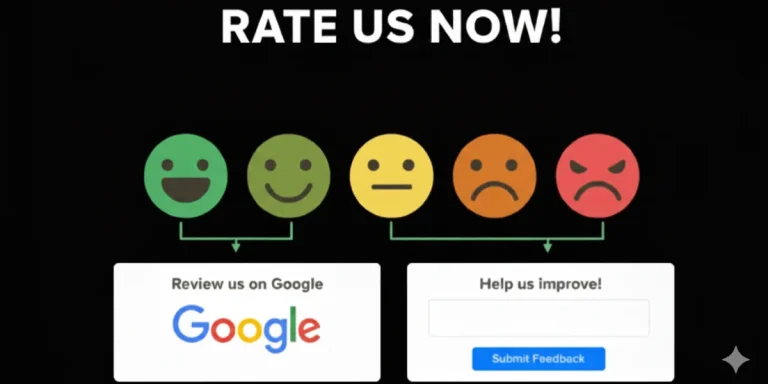
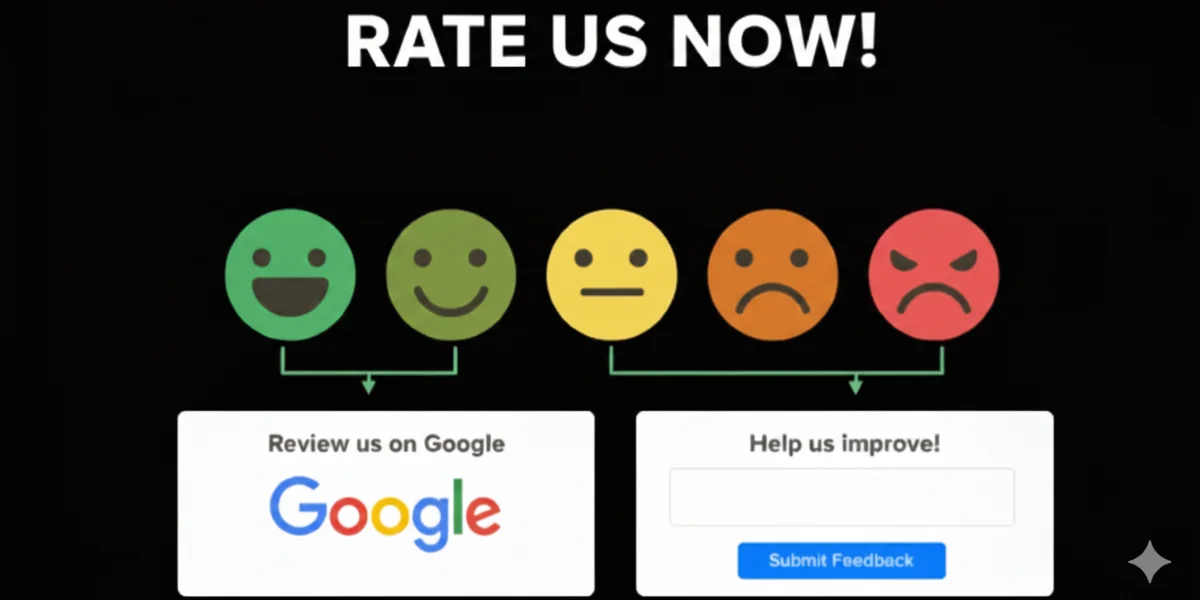
Review gating is the practice of pre-screening customers before asking them to leave a review. If someone indicates they had a positive experience, they’re directed to post a public review on Google or other platforms. If they indicate dissatisfaction, they’re routed to a private feedback form that never sees the light of day.
For example, a restaurant sends an email asking, “Were you satisfied with your visit? Yes/No.” Customers clicking “Yes” receive a direct link to Google Reviews. Those clicking “No” get sent to an internal feedback form instead. The result is an artificially inflated star rating that doesn’t reflect genuine customer experiences and misleads potential customers when making purchasing decisions.

Why is review gating prohibited?
Review gating violates both platform policies and federal regulations. Major review sites and government agencies have taken firm stances against this deceptive practice.
Deceives consumers
Filtered reviews create a false impression of business quality that misleads people relying on authentic feedback. Consumers make purchasing decisions based on reviews they believe are genuine, but gated profiles show only cherry-picked positive experiences while hiding legitimate complaints and concerns.
Undermines the review ecosystem
When reviews don’t reflect real experiences, the entire online review system loses credibility for everyone. Consumers start distrusting all reviews, businesses lose a valuable feedback channel, and the platforms themselves become less helpful in helping people find quality products and services.
Violates platform terms
Google, Yelp, and other major review platforms explicitly prohibit selectively soliciting positive reviews or discouraging negative ones. These terms of service exist to protect consumers and maintain platform integrity. Violating them puts your business listing and visibility at serious risk.
Breaks federal regulations
The Federal Trade Commission treats review gating as deceptive marketing subject to enforcement action and penalties. The FTC has made consumer protection in online reviews a priority, and businesses caught engaging in gatekeeping face investigations, fines, and public enforcement actions that damage their reputation.
Creates legal liability
Businesses engaging in review gating face potential lawsuits, regulatory fines, and reputational damage that far exceed the cost of negative reviews. Class action suits, state attorney general investigations, and competitor complaints can all result from this deceptive practice with costly consequences.
Google’s policy on review gating
Google explicitly prohibits review gating and has enforced this policy since 2018. Violating these rules results in severe penalties that can permanently damage your online presence.
Explicit prohibition in guidelines
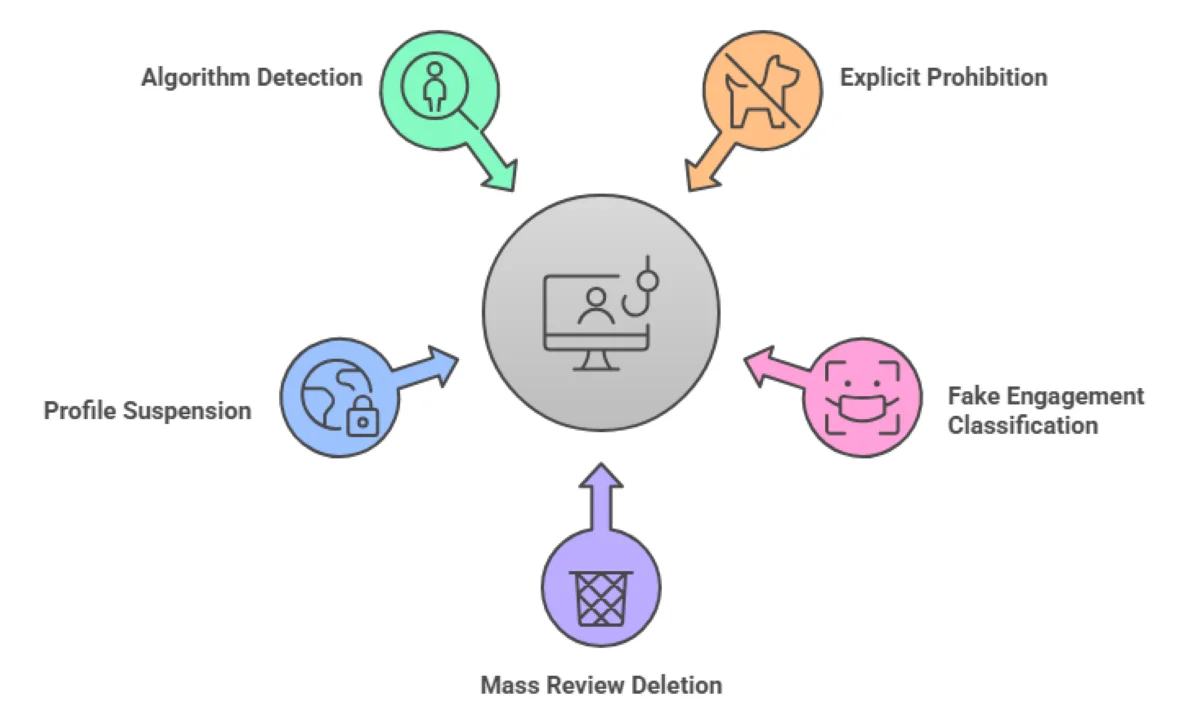
Google’s content policy clearly states businesses cannot “discourage or prohibit negative reviews, or selectively solicit positive reviews from customers.” This language leaves no room for interpretation; any form of filtering customers before requesting reviews violates Google’s terms and puts your listing at risk.
Classified as fake engagement
In 2022, Google moved review gating under the “fake engagement” category in its prohibited content guidelines. This classification puts review gating in the same category as fake reviews, review bombing, and other manipulative practices that Google actively detects and punishes with serious consequences.
Mass review deletion
If Google detects review gating, they may delete ALL your reviews, not just the gated ones, wiping out years of legitimate feedback overnight. This means even your authentic positive reviews disappear, leaving you with zero social proof and starting entirely from scratch.
Profile suspension risk
Your Google Business Profile can be suspended or permanently banned from the platform for review-gating violations. This makes your business invisible in local search results, Google Maps, and the knowledge panel, devastating for any business relying on local customers.
Algorithm detection systems
Google’s algorithms actively identify patterns consistent with review gating and automatically flag businesses for investigation. Unusually high ratings, sudden rating jumps, and suspicious review timing patterns all trigger detection systems that lead to manual reviews and penalties.
FTC guidelines and penalties
The Federal Trade Commission treats review gating as deceptive marketing. Recent enforcement actions and new rules have made penalties for this practice increasingly severe and costly.
2022 official guidance
The FTC released publications explicitly stating that businesses should not ask for reviews only from people they think will leave positive feedback. This guidance clarified that pre-screening customers based on satisfaction before directing them to review sites constitutes deceptive marketing under federal law.
October 2024 rule update
The new Consumer Reviews and Testimonials Rule enables courts to assess civil penalties for deceptive review practices. This rule significantly strengthened enforcement capabilities, making it easier for the FTC to pursue cases and impose substantial financial penalties on violating businesses.
Per-violation penalty structure
Fines can reach up to $44,000 per violation under the Consumer Review Fairness Act. Since each suppressed review can count as a separate violation, costs escalate quickly into hundreds of thousands or millions of dollars for businesses with significant review volume.
Incentive prohibition included
Conditioning rewards, discounts, or other incentives on positive reviews or specific star ratings is also explicitly prohibited. You cannot offer a discount for 5-star reviews or enter only positive reviewers into prize drawings. These practices violate FTC guidelines just like direct gating.
The real risks of review gating
Beyond regulatory penalties, review gating creates serious business risks that undermine long-term success. The short-term gain of better ratings isn’t worth the potential fallout.
Complete review history loss
Google can delete your entire review history in a single enforcement action, wiping out years of legitimate customer feedback overnight. This eliminates all social proof you’ve built, making your business appear new or untrustworthy to potential customers researching their options.
Immediate customer distrust
Consumers are savvy; they notice when all reviews are five stars and become immediately suspicious of your authenticity. Many shoppers specifically look for businesses with some negative reviews because all-positive profiles feel fake and manufactured rather than genuine.
Lost improvement opportunities
Negative reviews tell you exactly what needs fixing in your business operations, products, or customer service. Gating hides your blind spots and prevents meaningful improvements, while competitors who embrace feedback continuously get better and eventually outperform you.
Long-term competitive disadvantage
Businesses with authentic review profiles build stronger customer trust and loyalty over time than those gaming the system. When consumers eventually discover manipulated reviews—and they often do—the resulting backlash damages your brand far more than honest negatives ever would.
Permanent reputation damage
Studies show that more than half of the consumers will never do business again with a brand that breaks their trust. Once you’re caught gating reviews or exposed for deceptive practices, rebuilding that trust becomes nearly impossible, regardless of how much you improve afterward.
Why negative reviews actually help your business?
It sounds counterintuitive, but negative reviews can actually boost your sales and credibility. The key is understanding how consumers perceive authenticity online.
Strong authenticity signals
Consumers expect to see some negative reviews on any business profile they evaluate. An all-5-star rating immediately looks fake and triggers skepticism about whether reviews are genuine or manipulated. A few negatives among many positives actually increase overall credibility.
Higher conversion rates
Research consistently shows that products and services with ratings between 4.2 and 4.7 stars convert better than perfect 5.0 ratings. Consumers trust these slightly imperfect scores more because they reflect realistic customer experiences rather than filtered or fake feedback.
Free market research
Negative feedback highlights exactly what needs improvement in your business—products, service, policies, or communication. This is valuable insight you’d otherwise pay consultants thousands of dollars to uncover through surveys, focus groups, and mystery shopping programs.
Response opportunity
How you respond to criticism matters far more than avoiding it entirely. A thoughtful, professional response to a negative review demonstrates your commitment to customer satisfaction and can turn harsh critics into loyal advocates who update their reviews.
Proven trust-building
Brands like MeUndies respond to every 1-3-star review they receive with personalized, helpful responses. This practice has significantly boosted their customer engagement, repeat purchase rates, and long-term loyalty because customers trust brands that address problems openly.
The better approach: respond to every review
Instead of hiding negative feedback, the winning strategy is responding to every review, positive and negative. This builds trust, improves loyalty, and increases revenue.
Why responding matters
Responding to reviews directly impacts your bottom line in measurable ways. Customers notice when businesses engage with feedback and reward that attention with loyalty and increased spending.
- Most shoppers expect a response when they leave a negative review about their experience with your business.
- The majority of consumers read business responses to reviews before making their final purchasing decisions.
- Customers are significantly more likely to visit businesses that respond to negative reviews professionally and promptly.
- People spend considerably more money with businesses that actively respond to and engage with customer reviews.
- Most customers say businesses never respond to their reviews, creating a massive opportunity to stand out from competitors.
What a good response looks like
Effective review responses follow a simple formula that works across industries. They acknowledge feedback, show empathy, and offer solutions while maintaining professionalism.
- Acknowledge the specific issue directly, even if you disagree with the customer’s assessment.
- Apologize sincerely for their negative experience without making excuses or shifting blame.
- Offer a concrete solution or a clear next step to resolve their concern quickly.
- Keep the tone professional throughout—avoid defensive, dismissive, or emotional language entirely.
- Take detailed conversations offline by providing direct contact information for private follow-up.
The challenge: responding at scale
The biggest obstacle to effective review management isn’t knowing what to do—it’s finding time to do it consistently across all platforms.
- Crafting thoughtful, personalized responses takes time, most busy business owners simply don’t have.
- Generic copy-paste responses feel impersonal and often backfire with customers who see through them.
- Different sentiments require different tones—one template doesn’t work for all review situations.
- Delayed responses beyond 24-48 hours lose their impact and fail to satisfy upset customers.
- AI-assisted review management solves this challenge, making consistent responses practical for busy businesses.
How Spreadical can help with managing reviews?
Spreadical delivers an all-in-one toolkit designed to help businesses of any size easily manage, respond to, and learn from customer reviews—no matter the industry.
Google review booster
Reply to every review so customers feel genuinely heard and new visitors see you care about feedback. Consistent responses build trust and demonstrate your commitment to customer satisfaction across all your Google reviews.
Instant Google review sync
Every new review is delivered to your WhatsApp in real time with no manual checking needed. You’ll know immediately when customers leave feedback, allowing you to respond while the experience is still fresh.
AI-smart reply drafts
Get ready-to-send responses crafted by AI to match your brand tone and customer sentiment perfectly. Each draft considers the review’s rating and concerns to create responses that feel personal rather than automated.
Improve with a feedback loop
Spreadical learns from your edits and approvals, making replies more personal and accurate over time. The system adapts to your communication style and preferences, so drafts require less editing as you continue using it.
WhatsApp review control
Approve, edit, or auto-publish replies without ever leaving WhatsApp for maximum convenience. Manage your entire review response workflow from the same app you already use for business communication daily.

Frequently asked questions
Is review gating illegal?
Yes, review gating violates FTC guidelines and can result in fines up to $44,000 per violation under the Consumer Review Fairness Act. It also violates Google’s content policies and can lead to profile suspension or a permanent ban from their platform.
What happens if Google catches me review-gating?
Google may delete all your reviews, not just gated ones, wiping out years of legitimate feedback instantly. Your Google Business Profile can also be suspended or permanently banned, making your business invisible in local search results and Maps.
Can I ask customers for reviews?
Yes, you can and should ask all customers for reviews after their experience with your business. What you cannot do is pre-screen them based on expected sentiment or only ask those who are likely to leave positive feedback.
How should I handle a negative review?
Respond promptly within 24-48 hours, acknowledge the specific issue, apologize sincerely, and offer a concrete solution. Keep your response professional throughout and take detailed conversations offline by providing direct contact information for follow-up.
Will negative reviews hurt my business?
Some negative reviews actually help your business by making your profile appear authentic and trustworthy. Research shows ratings between 4.2-4.7 stars convert better than perfect 5.0 ratings because consumers trust them more.
How quickly should I respond to reviews?
Aim to respond within 24-48 hours while the experience is still fresh in the customer’s mind. Faster responses show customers you care about their feedback and increase the chance of resolving issues before they escalate or spread.
Can I offer incentives for reviews?
You cannot condition incentives on positive reviews or specific star ratings under FTC guidelines. Offering discounts for 5-star reviews or entering only positive reviewers into drawings violates regulations, though you can thank customers generally.
What’s the difference between review gating and review solicitation?
Review solicitation means asking all customers for feedback regardless of their expected sentiment, which is legal and encouraged. Review gating means filtering customers and only directing satisfied ones to public review sites while hiding negative feedback.
How does AI help with review management?
AI drafts personalized responses matched to customer sentiment automatically, saving significant time while maintaining quality and authenticity. You always review and approve before posting, staying in complete control of your brand voice.
Why manage reviews through WhatsApp?
WhatsApp delivers reviews in real time where you already communicate, eliminating the need to constantly check separate dashboards. You can approve, edit, or post responses with a single tap from your phone anywhere.